
Throughout the six-series of Joe Weisberg’s cold-war spy drama, The Americans, Philip Jennings, a KGB agent for the Soviet Union’s ‘illegals’ programme, is, at once, a committed husband, a devoted father and a proficient spy. Indeed, it is through the potent coalescence of these three titles that Philip’s resolve is challenged and he is subsequently forced to question his loyalty to the cause that he originally pledge his life to: to serve his country. For Matthew Rhys, the Cardiff-born actor who portrays The Americans’s co-protagonist, the principle objective for Jennings was to ensure the safety and the security of his children, Paige (Holly Taylor) and Henry Jennings (Keidrich Sellati) , even before that of his steadfast loyalty to his government[1]. However, throughout the fifth series, Philip’s own childhood, and how, as an adult, he finds a father-figure with his and his wife’s, Elizabeth’s (Keri Russell), handler, Gabriel (Frank Langella) is foregrounded. Whilst Philip’s priority is that of protecting his family from the dangers of his and Elizabeth’s lives as ‘illegals’, it through his accord with Gabriel that Philip voices not only his concerns for the Centre’s practices but also his longing wish to understand the history of his family’s past and their lost generation.


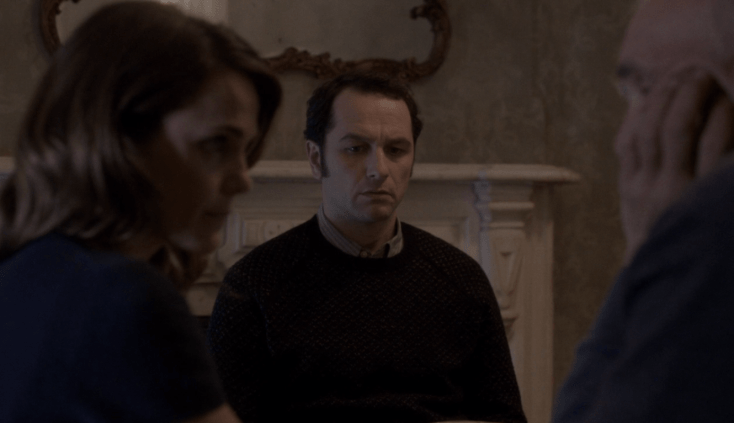
Do Mail Robots Dream of Electric Sheep
Following Gabriel’s introduction in EST Men, the season’s first episode, a discordant undercurrent runs through his meetings with Philip and results in their once close relationship becoming strained. The pair’s dispute over the indoctrination of Paige into ‘the second-generation illegals programme’ (Echo, season two, episode thirteen) creeps from the shadowed peripheries to the forefront of their personal and professional exchanges: Philip vehemently opposes the Centre’s intention, believing that his daughter’s future should be her own, whilst Gabriel, as an intermediate representing the interests of their ‘organisation’ (Do Mail Robots Dream of Electric Sheep?, season three, episode nine), disagrees with Philip’s protective stance. For Philip, two issues, or oversights, draw him into opposition with the Centre, and, therefore, Gabriel: the unpredictable, and often fatal, dangers of their work and the seemingly complete disregard for Paige’s own decision towards her future. Philip’s repeated point of an agent’s ‘choice’, using himself as an example, having elected, in April 1962[3], to ‘live this way’ as an ‘illegal’ in America, is countered by Gabriel’s reassurance that ‘Paige will have a choice’, a reassurance that Philip himself cannot hold fast to in light of Elizabeth’s intention to follow through with the organisation’s line, exposing their daughter to her beliefs and ideologies (Open House, season three, episode three). This doubt, to an extent, resurfaces and is voiced within Do Mail Robots Dream of Electric Sheep? in response to Gabriel attempt to uncover the source of Philip’s despondency:
Gabriel: Philip, would you like to tell me what is going on? You’re not in this alone, you know. Elizabeth loves you. I love you. What’s the problem?
Philip: The–the problem? The problem is you, Gabriel, and all this talk. All this talk. Because you think you can wrap me around your little finger. But I am not Elizabeth
Gabriel: I’m aware of that.
Philip: I trusted you. I trusted you. And your job was to look out for me. It was. And now my job is to look out for my family, because no one else will. (Do Mail Robots Dream of Electric Sheep?, season three, episode nine)
Before analysing the scene, it is important to define the context surrounding Philip’s sombre outlook upon his then ongoing series of personal complications and operational requirements: within Salang Pass, the fifth episode of the season, Gabriel identifies the sheer volume of managing ‘Paige, Kimberly (Julia Garner) [the fifteen-year old daughter of Isaac Breland, the head of the CIA’s Afghanistan division[4], whom Philip, or ‘Jim’, must seduce in order to gain access to her father’s home-office], Martha (Alison Wright) with her baby fever’ in tandem as an understandable burden, even for the Centre’s ‘best’ agent. Further to this, within the following episode, Born Again (season three, episode six), Gabriel reveals the internment and impending trial of Philip’s past-girlfriend and now disgraced rogue KGB ‘illegal’, Irina Semenova[5] (Marina Squerciati), and his knowledge of Philip and Irina’s twenty year old son, Mischa (Alex Ozerov), a soldier ‘in the 345th Independent Paratroop Regiment, in Faizabad’. However, as is noted within the long-excerpt from the concluding scene of Do Mail Robots Dream of Electric Sheep? Philip does not attribute his ‘problem’ to either the possibility of Paige’s recruitment, the morality surrounding his operations, or the uncertain fates facing both Irina and their son, but rather holds Gabriel himself accountable for his crestfallen mind-set.

With regards to the extract, Philip, rather ambiguously, levels two personal failings at his handler: he perceives Gabriel to be manipulative and then labels his handler’s duplicity as an act of betrayal. Firstly, and when analysing the series holistically, Philip’s reference to Gabriel’s disingenuous ‘talk’ with him is somewhat ironic; within season six, Elizabeth, like Philip with Gabriel, chides her husband’s inclination of giving ‘speeches’ to her (Dead Hand, season six, episode one) and his penchant, his ‘love’, for ‘big talks’ (The Great Patriotic War, season six, episode five[6]) as mere trivialities, without use as by-products of his time spent in EST. Here, through the pair’s dialogue, Gabriel’s loquacious nature, previously discussing his interest in entomology and then evidencing this by delineating the origins of the word ‘amatory’ over a game of scrabble, is for Philip a strategy designed to control and dissuade him from his staunch opposition to the Centre. The ‘talk’ that Philip speaks of suggests that the subject of their conversations, including their past meetings, is nothing more than a method of subterfuge utilised by Gabriel to deceive Philip: the determiner ‘this’[7], from ‘all this talk’, indicates Philip’s perspective towards his relationship with Gabriel, as the latter’s jocularity is simply a tried and frequently repeated characteristic of their exchanges. This perceived insincerity highlights, through the determiner ‘this’, Philip’s belief that their conversations leading to this point, whilst typically remaining tied, to an extent, to operat1ional matters and their implications, have been geared towards manipulating him in order to keep Philip within the fold, and is a strategy that Gabriel has, to Philip, successfully enacted with Elizabeth.


March 8, 1983
Following his declaration to protect his family against the Centre at the conclusion of Do Mail Robots Dream of Electric Sheep?, Philip’s subsequent undermining of the Centre’s orders is carried out, as he claimed it would be, in the interest of his wife and daughter: despite Gabriel’s, and the Centre’s, refusal, Philip ensures that Elizabeth, in direct convention to his chain of command, has the opportunity to have a final farewell with her dying mother, as she travels overseas to West Germany accompanied by Paige, the teenager at the heart of Philip’s conflict with Gabriel. With Philip’s previous vow to ‘look out for my family [sic]’, it is only now, following Elizabeth’s and Paige’s departure to West Berlin, that Gabriel responds to his agent’s promise, or threat, to the Centre.

After her first meeting with Gabriel, an inquisitive, yet appropriately bemused, Paige succinctly summarises her parents’ relationship with their handler, as she notes to Elizabeth and Philip that ‘he’s like your family’ (The Committee on Human Rights, season five, episode seven), to which the pair concur. Despite his knowing of everything about her and his gift of her favourite childhood toy, the ‘stuffed tiger’, Jessie, when she started kindergarten, there is an inevitable distance between Paige and Gabriel, and yet his love and ‘care’ (The Committee on Human Rights, season five, episode seven) for her mother and father is apparent to Paige at the point of their first and only meeting as a collective. This notion of Gabriel’s ‘care’ for the Jennings is consistently revisited throughout his time supervising their clandestine operations, from his acknowledgment of paternal ‘love’ for Philip (Do Mail Robots Dream of Electric Sheep?, season three, episode nine) when attempting to understand the ‘problem’ plaguing his agent’s mind-set towards their work to Claudia’s (Margo Martindale) observation to Gabriel that ‘You [sic] care about him [Philip]. We both do’ when debating their joint approach to containing the disruption brought about by Philip’s ‘wayward son’, Mischa (Lotus 1-2-3, season five, episode five). Extending beyond the matter of a duty of care to his agents, in regards to a professional remit, Gabriel assumes, more so with Philip than with Elizabeth, a familial-role within their lives; for Philip, Gabriel is a father-figure. This filial-dynamic, however, is fraught with disagreement, especially over Philip’s aversion to adhering to the Centre’s protocols and requests when the rules in place are in direct opposition to his wishes for his family:
Philip: Look, they are already there, and no one blinked at her passport. All the Centre has to do is pick them up at the hotel and take them across the border.
Gabriel: As far as you know, nobody caught the passport. This isn’t how we do things, Philip. There’s a chain of command.
Philip: I told you I was gonna take care of my wife and my family. This is her last chance to see her mother, Paige’s only chance to meet her grandmother. I’m sure the Centre can understand that. I know they certainly wanted her connected to her roots.
Gabriel: You can’t blackmail the organisation this way. You’re acting like a child.
Philip: You can say what you want to say. I’m just getting done what I need to get done.
Gabriel: You can’t see 10 feet in front of you. I’ve done nothing but try to take care of you, and because you’re not getting what you want you think I’m the enemy. And when Elizabeth doesn’t see everything exactly the way you see it, you think there is something wrong with her. You know who there’s something wrong with? Grow up. (March 8, 1983, season 3, episode 13) (Emphasis added)
Whilst Philip’s anxious disquiet over the issue of Paige’s freewill, or the lack therefore, to decide whether or not to follow in her parents’ example will be discussed at length in the third instalment of this series, the dialogue, here, between Philip and Gabriel encapsulates the conflict of the pair’s season-long relationship: despite Philip assuming a patriarchal authority throughout the scene, having taken ‘care’ of his family by ensuring that Elizabeth has a final goodbye with her dying mother, and for Paige to actually meet with her grandmother, in Kruezberg, West Berlin[8], he is still chastised like a disobedient child for his disregard for the Centre’s practices.


Crossbreed
In accordance with the ever evolving priorities of and subsequent directions from the Centre, each season resets the conditions dictating the Jennings’ personal responsibilities and the parameters within which they enact their duties, either at home or in active service when undertaking their operations. Following the conclusion of season three, a workable level between Philip and Gabriel is reached. During season four’s opening episode, Glanders, Gabriel’s further reproach of his agents’ deception, Elizabeth included, leads to a simple ultimatum: if he cannot trust his agents then he will ‘go back to retirement in Sergach’. It is a decision that the Jennings easily respond to, with Philip’s wish to acknowledge Gabriel as their superior and their handler taken from a silent nod. Indeed, whilst Gabriel’s authoritative command for Philip to ‘grow up’ concludes season three’s narrative-arc between the pair, Philip, nevertheless, remains dubious of the Centre’s intentions and continues to disapprove of Paige’s recruitment. Despite this, however, Philip’s relationship with Gabriel returns, albeit with a reserved sense of trepidation, to a bond akin to the status-quo before the disclosure of the Party’s ‘second-generation illegals programme’ (Echo, season two, episode thirteen). In light of Gabriel’s announcement to the Jennings of his retirement (Crossbreed, season five, episode six) and his impending return home to Sergach, Philip and Gabriel, during their final week together, speak more candidly with one another. As the close of their active service together quickly approaches, both men, trusting of the other, discuss their pasts: in both instances Philip initiates their conversations in order to, within Crossbreed, clarify his own understanding of father’s profession and then, upon the evening of Gabriel’s departure home to Russia, asks his erstwhile handler to elucidate an earlier reference made to the ‘terrible things’ (The Committee on Human Rights, season five, episode seven) he committed in service to their country. It is a dynamic indicative of their relationship prior to the prospect of Paige’s involvement with the Centre’s second-generation programme, and presents Philip and Gabriel as two agents still haunted by their recollections.

It is useful when constructing an overview of the characters’ narrative-arc together to outline the key seasonal points of Philp and Gabriel’s relationship: for season three, broadly speaking, the pair’s exchanges centre upon Paige’s indoctrination, the seduction of Kimberly Breland, the handling of Martha Hanson’s paranoia, the repercussions of the Soviet-Afghan War and Mischa’s active service upon the war’s frontlines; for season four, beyond continuing the listed ongoing operations, the priority of ascertaining ‘samples’ (Glanders, season four, episode one) of the Americans’ advancements in biological warfare takes precedent, with Gabriel’s personal supervision of the bioweapons scientist William Crandall, a KGB source subcontracted to the Department of Defence’s bioweapons division[9], highlighting the toll of their work when performed alone; finally, for season five, the focus of their operations are principally drawn to attaining a sample of an American-grown ‘super-wheat’ (Crossbreed, season five, episode six), and following the orchestration of Martha’s extraction from the US and Gabriel’s management of an itinerant Mischa, a wandering son looking for his father in America, Gabriel concludes his service as a KGB handler for the Jennings. During Crossbreed and The Committee on Human Rights, the pair’s final meetings are absent of the underlying father-son conflict of season three, with Gabriel attempting to gauge and quell Philip’s often hostile temperament towards the Centre, respectively, as their dialogue now gives way to a familial care and compassion for one another.

Crossbreed, written by Stephen Schiff and directed by Roxann Dawson, is an episode that is permeated by the subject of family, as several scenes portray families, specifically the children of these families, coping with challenges: instances include Gabriel’s reassurance to an overworked Elizabeth; Mischa’s return to Russia; Stan Beeman and Dennis Aderholt’s (Noah Emmerich and Brandon J. Dirden) attempt to recruit Ms Kovalenko (Darya Ekamasova) — a TASS News agency worker[10]— by discussing her child’s ‘future opportunities in America’; Gabriel’s remorse for having ‘lied to’ the Jennings for the first time; Henry and Stan’s dinner; Oleg’s stand against the CIA’s attempts to blackmail him, as his mother watches on with ‘distant eyes’ as he makes his decision; Elizabeth looking regretfully at the new family living at the Seong residence[11]; Philip’s recalling of his childhood encounters with ‘lowlifes’ in the streets of Tobolsk, who may or may not have been family to ‘the kids who used to beat [Philip] up’, and, following this, his questioning of his mother’s claim that his father was a logger[12]; before concluding with Paige meeting her parents’ handler. It is with this penultimate entry that Schiff defines Philip and Gabriel’s familial bond: as the former, acting upon the advice of Elizabeth, asks Gabriel, an authority upon Philip’s personal records, to clarify the validity of his knowledge of his family’s livelihoods. However, as Philip searches for answers regarding his father’s ties to the government, Schiff ultimately affirms Gabriel’s position as Philip’s only guardian, as the little truth Jennings’s knows about his family is made strikingly clear:
Philip: When are you leaving?
Gabriel: A week, at most.
Philip: Are you ill?
Gabriel: No.
Philip: So, you’re not keeping anything from me?
Gabriel: It’s time for me to go.
Philip: My father — I want to ask you. My mother — never really talked about him, but I’m having these memories. He was quiet– very. My mother didn’t talk about him, really. She said they… met at a movie at … a workers’ club. They knew each other a month before they got married. And she said that he was a logger. And that’s all I know. He used to bring things home. Was he a logger?
Gabriel: He worked at a logging camp.
Philip: Was he a logger?
Gabriel: He was a guard.
Philip: A guard?
Gabriel: Yes.
Philip: What kind of camp was it?
Gabriel: A penal camp.
Philip: Why didn’t you tell me?
Gabriel: I didn’t think it was my place to tell you.
Philip: Did he ever kill anyone? People who were trying to escape?
Gabriel: I have no idea.
Philip: You saw his file.
Gabriel: I never saw records like that. Some guards were cruel. Some were kind. I didn’t know your father.
Philip: Who did he work for?
Gabriel: Us.
Philip: So that’s why you came for me.
Gabriel: No. We were always on the lookout for talented people, and you were talented. The fact that you came from a trustworthy family, that was good. Those were different times, Philip. It’s hard to explain. Who knows what your father did. He had his job. A lot of things happened. You think it was his fault? (Chuckles). He was nobody. We were all nobodies. It’s been over for a long time.
(Crossbreed, season five, episode six)
As opposed to Philip and Gabriel’s antagonistic exchanges during both Do Mail Robots Dream of Electric Sheep? and March 8, 1983 excerpts, here, Philip visits Gabriel not as a protective father nor as an agent defending his insubordinate behaviour, but rather as a son wishing to know the truth about his family. Philip’s constant use of interrogative sentences evidences the extent of his need to understand the enigma of his father, a stoically silent man who was, seemingly, more of a stranger than a parent to Philip. This line of questioning, however, is ultimately, yet not intentionally upon his part, directed by Gabriel; Philip lacks any knowledge of his father’s profession and so he holds fast to Gabriel’s responses, allowing Gabriel’s answer to dictate the sequence of his questioning. Further to this, note Philip’s echoing of Gabriel’s replies, isolating the head nouns of ‘guard’ and ‘camp’, in order to accentuate the extent of the dichotomy between fact from his mother’s fiction. By repeating these two words Philip conveys his frustration at having known so little about his father and his sense of anger at, as a child, being lied to by his mother. The reiteration of these nouns, whilst somewhat limited in terms of the specific details surrounding his father’s service, and his subsequent questions are uttered with apprehension, as though Jennings is now hesitant to hear further explanation. This repetition conveys Philip’s conflict: he wishes to know more about his father, but with this knowledge comes the prospect of uncovering the possible atrocities his father may have committed in his post as a guard.


Through his concluding delineation, Gabriel, rather conversely to Philip, believes the act of trying to define the specific incidents of one’s service to be unimportant: to him, the context in which one performed their duties is the essential matter. There are two outcomes from the pair’s meeting: first, that Philip’s father was, like Gabriel is himself, a product of his time, enacting a duty within the confines of a ‘different’ era, and the second is that of Philip’s wish to be more open with his daughter about his and her mother’s identities. In regards to the former, Gabriel’s dialogue is clipped, without superfluity, and declarative in its delivery as he fails to see the value of Philip’s somewhat naive attempt at establishing, in hindsight, a complete profile of his father and his responsibilities. The generational gap between Philip and his father prevents the former from fully comprehending the challenges facing any of his antecedents. Gabriel’s attempt to explain this disparity to Philip is shown through his complete dismissal of identity. To begin with, his successive use of the common nouns ‘job’, ‘things’ and ‘nobodies’ counters Philip’s search for clarity, as Philip’s previous reiteration of his father’s title of a ‘guard’, whilst already nondescript, is reduced in its specificity even further. In addition to this, the reference to the events, or ‘things’, which happened to or were committed by his father are without worth in Gabriel’s response, and are deemed inconsequential. Finally, the notion of these people, Gabriel included, as being ‘nobodies’ is in direct contrast to Philip’s thought process. Having committed himself to the EST programme, Philip is drawn to honesty (The Magic of David Copperfield V: The Statue of Liberty Disappears, season four, episode 8), analysing his own beliefs and opinions, and develops the penchant for placing the self at the forefront of his thoughts. For Gabriel, the individual gives way for the betterment of the collective as a whole. Philip’s view of his father, due to his hindsight, will forever be askew.
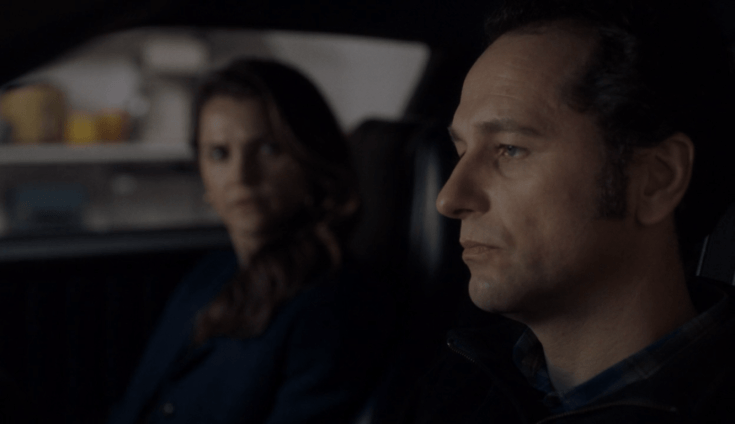
Mike Hale, in his review of the episode for the New York Times, adeptly analyses Gabriel’s ‘valedictory’ as a form of inheritance, with a younger generation shouldering the damaging aftermath of their forbearers, as he states ‘The older generation — the one that created the Soviet system — is stepping away and leaving its children to deal with the moral and practical fallout’[14]. Evidently, as Hale notes, Gabriel and Philip’s narrative arc, and the subject of fatherhood, evidences The Americans’ focus upon family, and the consequences of one generation’s actions upon the lives of their descendants. It is a consideration that Philip, in either his search for his father’s true identity or in his wish to protect his children from his life, has been frequently drawn to. Therefore, as previously outlined, Philip’s meeting with Gabriel results in the former’s reflection upon his own relationship with his daughter, Paige, and the lack of transparency he has permitted between them, as he summarises to Elizabeth:
Elizabeth: What’s going on?
Philip: I spoke to Gabriel about my father.
Elizabeth: What’d he say?
Philip: He was a guard — at a prison camp. You know anything about the camps?
Elizabeth: I know they existed.
Philip: I’m not sure why my mother didn’t tell me. Maybe she didn’t like what he did. I didn’t know anything. My own parents — I didn’t know anything about them at all.
(Crossbreed, season five, episode six)
Here, Philip’s reference to not knowing ‘anything about’ his mother and father serves as an evident analogy of the Jennings’ own clandestine lives being unbeknownst to their children. In light of his talk with Gabriel, therefore, Philip acquiesces in his opposition to Paige’s inclusion within their profession by bringing his daughter to meet with Gabriel himself. Further to simply strengthening his own relationship with his daughter, Paige’s introduction to Gabriel, whilst giving her a clearer understanding of her parents’ other life, also establishes the regard within which Philip holds his handler: Paige, first and foremost, is meeting her mother and father’s custodian and who is later deemed by Paige herself to be someone akin to a member of their own family.
The Committee on Human Rights
Written by Hilary Bettis and directed by Matthew Rhys — the episode is the second of three episodes directed by Rhys (The Magic of David Copperfield V: The Statue of Liberty Disappears, season four, episode 8 and Tchaikovsky, season six, episode two[15]) — The Committee on Human Rights concludes with Philip and Gabriel’s final farewell, with the pair unlikely to ever ‘see each other again’. It is a definitive end to the pair’s tumultuous service together and unlike their previous meetings it is Gabriel, as opposed to Philip, who discloses not only the toll of his involvement in performing the government’s orders but also his reservations about Paige’s recruitment into the Centre’s ‘illegals’ programme. The scene centres upon Gabriel’s morality and the guilt he feels in fully committing himself to ‘setting an example’ of devotion and loyalty to their organisation. Like Crossbreed, Philip, again, assumes the role of inquisitor, but, here, rather than search for answers pertaining to his own history he instead wishes to clarify Gabriel’s, specifically the latter’s reference to the ‘terrible things’ he committed both before and after the war. Contextually, further to his recounting of his pre-and post-war service, Gabriel is an agent living, evidently, with remorse, as is Philip and, here, their discourse is grounded by a shared sense of abjection to their own work, regardless of the ‘higher purpose’ they adhere to. The individual must endure the memory of their actions and it is an outcome that both Philip and Gabriel continue to face. The scene’s dialogue has been quoted in its entirety:
Philip: I’m sorry you’re leaving. Really.
Gabriel: That’s good of you to say. We’ve had our ups and downs. I’m glad it’s all ending on this — you know, something good. I doubt we’ll ever see each other again.
Philip: What’s this thing Elizabeth’s doing in the psychiatrist’s office?
Gabriel: She got us some information on people who are part of a well-organized opposition to the party at home.
Philip: Can I ask you something? You said when you were younger, you did (sighs) terrible things. What things?
Gabriel: When you signed up how much did you know about what we did before and after the war?
Philip: People were talking about it.
Gabriel: What did you think?
Philip: I didn’t. I didn’t ask questions.
Gabriel: Well, it was bad. It was worse than you could imagine. People were shot, worked to death in the camps. Some were counterrevolutionaries. But some…. some hadn’t done anything. Just people. I did it too.
Philip: Why?
Gabriel: To set an example. I, uh — who knows? The organisation was filled with people who were scared and confused.
Philip: But not you?
Gabriel: No. I believed I was acting in the service of a higher purpose. But I was just scared. It was terrible, terrible times. And a lot of us — a lot of us didn’t make it either. I have to go.
Philip: Is Stan Beeman’s new girlfriend one of us?
Gabriel: Are you serious? (Sighs) You’re losing it, Philip.
Philip: That’s not an answer, Gabriel.
Gabriel: No. It’s possible the Centre wouldn’t tell me because they knew you’d ask me this question. As far as I know, she is not one of us. You were right about Paige. She should be kept out of all this.
(The Committee on Human Rights, season five, episode seven)
In each of the quoted extracts from the series, the entwined subjects of family and work have surfaced throughout Philip and Gabriel’s conversations, meeting in order to receive operational instructions that frequently encroach, either deliberately or unintentionally, upon the Jennings’ home-life. Akin to the pair’s exchanges within Do Mail Robots Dream of Electric Sheep?, March 8, 1983, and Crossbreed, the often united themes are evident throughout Philip and Gabriel’s discourse here at the close of The Committee on Human Rights.


From Stalin’s acquisition of supreme power at the end of the 1920s to his death in 1953, it has been estimated that over three-quarters of a million people were executed in the Soviet Union, while at least two and three quarter million died in the camps.
In this atmosphere of terror, fear and mutual recrimination, anything out of the ordinary could become the pretext for arrest, imprisonment, torture and execution[16].
Of Evan’s listing of the government’s despotic controls, outlining the consequences facing the Russian people under Stalin’s reign, Bettis references this terror through Gabriel’s admission of his involvement in carrying-out such actions. Despite Gabriel initially professing his selfless fidelity towards the ‘higher purpose’ of their government, and his clarity of vision, he ultimately concedes to enacting his duties out of a sense of fear permeating the country, both preceding and succeeding the second world war, as he states ‘I was just scared. It was terrible, terrible times’. Up to this point, Philip had viewed Gabriel as a stalwart of the organisation, believing his handler to be unwavering in his devotion and one who was often in disagreement with Philip’s disapproval of the unrelenting demands of the Centre’s. However, akin to Philip himself, Gabriel reveals an outlook upon his past darkened by his own acts of cruel brutality, specifically when serving as an executioner for the organisation. Through Gabriel’s reference to his memories of the executed, ‘just people’, in some instances, alongside ‘counterrevolutionaries’, Bettis, akin to Evans, identifies the complete subjectivity of the government’s judicial process: innocent or guilty, no one was safe. When detailing his service, the homonym ‘just’ forms a duality to Gabriel’s description of his victims. Here, ‘just’ is an adverb, as Gabriel is referring to the complete innocence of those people, fellow citizens, nothing more, who were murdered without inciting provocation or for any discernible reason; however, the adverb when spoken by Gabriel, and in addition to the previously stated meaning, can be seen to reference, as an adjective, the morality of those individuals, as the humanity of those ‘just people’ is placed in stark contrast to Gabriel’s own criminal acts[17]. With this utterance, Gabriel’s victims are characterised by their decency. Bettis establishes the gravitas of Gabriel’s service through this avowal, as the Jennings’ infallible handler, now ashamed, reveals his underlying disgust at his own record of devotion.

In addition to his shame, Gabriel reveals a devastating truth to Philip: he cannot remember the reasons behind his motivations, and it is a truth that is echoed by Philip at the conclusion of START, the final episode of The Americans. The fallibility of memory plagues Gabriel here, as he struggles to recall the purpose behind his execution of civilians, and, as a result, elides his personal intent. A typical attribute of Philip is to analyse the purpose of his orders, to question, and now Gabriel, unable to explain the objective of his past criminal acts, is ultimately unable to delineate the history of his own service. This point, albeit over a less extreme circumstance, is mirrored by Philip when, speaking to Elizabeth, he confesses that he cannot recall the name of a superior, as he states, ‘Colonel…I can’t even remember his name now’ (START, season six, episode ten). After everything that these agents commit to, the individuals who give the orders and the orders themselves are lost to them.

From Gabriel’s account, Bettis unites Philip and Gabriel in their shared dejection towards the organisation, and yet Rhys, in his directing of the scene, keeps the characters physically distant within the space of the room. It is a subtle contrast, but is one which is apparent when compared with Elizabeth’s earlier, and final, meeting with Gabriel. Elizabeth, bringing with her the boon of a sample of Stobert’s (Brett Tucker) ‘super-wheat’, meets with Gabriel in the sun-filled kitchen of his safe-house. As the scene ends, agent and handler are affectionately holding hands, heads bowed, with their intimate embrace framing the plant centred between them. Conversely, for Philip’s farewell, the room is enveloped in a grey hue as the pair sit separately from one another; the extracted crop, mirroring Elizabeth’s final meeting with Gabriel, is positioned, again, at the centre of the frame. The scene conveys the disparity between Elizabeth and Philip’s relationship with Gabriel; indeed, whilst far more harmonious with Elizabeth, Gabriel and Philip are, in essence, guardian and ward, respectively, with a somewhat turbulent history together, which has extended beyond the parameters of an operational remit[18].


References
[1] https://art19.com/shows/i-think-youre-interesting
[2] http://theamericans.wikia.com/wiki/Philip_Jennings: spelling
[3] https://www.youtube.com/watch?v=JCzLE5XaV_4&index=4&list=PLTGZBedA8J_y5g4mHioyLsYnC0FnCd2D5
[4] http://theamericans.wikia.com/wiki/Isaac_Breland
[5] http://theamericans.wikia.com/wiki/Irina_Semenova
[6]https://www.youtube.com/watch?v=7lkFBvng7uM&list=PLTGZBedA8J_wYTIG6F73dnjnyYk95mWGF&index=6: a thank you to the channel for uploading the clip from the episode.
[7]https://www.google.co.uk/search?q=this+definition&oq=this&aqs=chrome.0.69i59j69i57j0l4.1102j0j7&sourceid=chrome&ie=UTF-8- just to clarify the world classes of ‘this’
[8] https://tv.avclub.com/the-americans-march-8-1983-1798184070: consulting article to check the destination of Elizabeth and Paige
[9] http://theamericans.wikia.com/wiki/William_Crandall
[10] http://theamericans.wikia.com/wiki/Sofia_Kovalenko_Bystrova
[11] http://theamericans.wikia.com/wiki/Crossbreed: Elizabeth’s remorse was an observation that I had not consider or noticed before.
[12] This article was read after writing this paragraph. Similar points are made in regards to the episode’s attention to the theme of family: https://tv.avclub.com/an-acting-showcase-for-the-americans-is-enhanced-by-sho-1798191306
[13] http://theamericans.wikia.com/wiki/Gene
[14] https://www.nytimes.com/2017/04/11/arts/television/the-americans-crossbreed-recap.html
[15] https://www.imdb.com/name/nm0722629/#director
[16] Evans, Richard. J, The Third Reich in Power 1933-1939, (London: Penguin Books, 2006), p. 66.
[17] Clarifying the word-class.
[18] https://tv.avclub.com/a-major-character-bids-farewell-as-the-americans-ponder-1798191879: this article was read after my comparison between the two scenes. No overlap or reiteration of points was intended.
[19] http://theamericans.wikia.com/wiki/Gene
[20] https://tv.avclub.com/a-major-character-bids-farewell-as-the-americans-ponder-1798191879
[21] Ibid.
 Words on Pages
Leave a comment