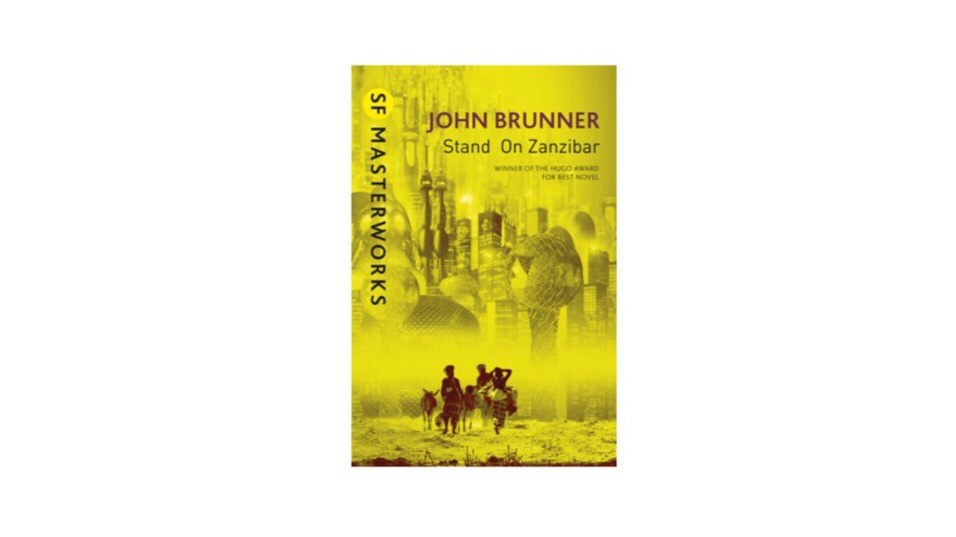
Picture an overcrowded, technology addicted world where war looms between the United States and a reclusive communist country in the Far East. In the US, Cannabis has been legalised and commodified according to strain and strength, while smoking tobacco is unheard of; entertainment is personalised, living space at a premium, and people live in fear of terrorist attacks, racism, and spree killers. Politicians are weak while vast technology companies hold all of the real power.
The year isn’t 2019 – it is 2010, as imagined on “a Smith Corona 250 electric typewriter fitted with a Kolok black-record ribbon”[1] by British writer John Brunner between summer 1966 and early 1967.
 The surprise isn’t that Stand on Zanzibar, like many science fiction novels, gets so many predictions right about the future; the surprise is how little the novel is talked about now, with its vision coming true around us. As reviewer and blogger Jesse Hudson put it brilliantly, “Perhaps it is John Brunner’s misfortune that his career was established in the world of science fiction.”[2]
Hudson puts Zanzibar alongside Brave New World and Nineteen Eighty-Four in terms of importance and prescience. In a way Brunner’s novel is a pragmatic distillation of the two – a kind of superficially luxurious world filled with distractions but shorn of privacy or freedom. Brunner’s world is no Oceania or World State; it is at once less extreme and far more untidy. In this it is far closer to our own.
But what really sets Zanzibar apart is its execution—the way Brunner has presented the world. As we will see, the way the reader digests the novel anticipates the chaotic, non-linear way we absorb information in the 2010s.
Closely following the stylings of John Dos Passos’ U.S.A. Trilogy (published 1930—1936), Brunner presents 2010 as a heap of broken images—crabbed newsreels, jumbled advertisements, fragments of narrative and more. The result for both work is a novel as archive or repository; U.S.A. is a document of its early 20th century namesake, while Zanzibar uses the same approach to create a future history: an artefact from 2010 digested in 1966.
Like Dos Passos, Brunner splits his novel into four different narrative modes and cycles through them:
- Context: cultural artefacts from 2010, such as adverts, articles, extracts from books;
- The Happening World: fragments of news stories, obituaries and headlines presented in a continuous stream;
- Tracking with Closeups: fragmentary vignettes and interludes focusing on minor characters, peripheral to the main narrative;
- Continuity – the main plot, told conventionally.
Compare Brunner’s four modes with Dos Passos’:
- Newsreels: cultural artefacts from 1900-1930, including newspaper headlines, articles, and fragments of popular songs;
- Biographies: compact lives of various American figures such as Henry Ford;
- The Camera Eye: stream of consciousness sections tracing Dos Passos’ life, impressions, and growth as a writer;
- The main narrative.[3]
Brunner has refactored Dos Passos’ modes as film and television devices: namely editing (Continuity), visual storytelling (Context), camerawork (Tracking with Closeups) and what resembles the name of a documentary programme (The Happening World). In this way, the entire world of 2010 has been reshaped to fit the tropes of television production, broken into fragments in the same as information is for transmission. Indeed, the contents page serves to illustrate this, presenting us with 118 separate chapters listed not chronologically (either in terms of where they are in the story or in the text itself), but by their narrative mode.[4]
Presenting the contents like this in itself serves as exposition, illustrating a reality that has been chopped up and presented piecemeal for consumption. It is also a provocation to the reader: it empowers them to consume the novel however they want, reading the chapters in any order, while at the same time providing a faulty map of the narrative. It is reminiscent T.S. Eliot’s deliberately opaque notes to The Waste Land—something presented as a paratextual aid to understanding which in fact the complete opposite: a part of the text and one intended to confuse the reader further.
Brunner even challenges the notions of both the book’s beginning and ending. The first section is numbered (0) and comes before the contents page[5], while the last section is a word from author himself: “This non-novel was brought to you by John Brunner…”[6]. And there is it is: non-novel, one that stretches beyond its proper beginning (section (1)) and, apparently, its ending; it’s a novel that tells the reader that it doesn’t exist. This is the other key feature of Brunner’s 2010 communicated here, and one many commentators may find prescient—the essential inauthenticity of it. In the words of a song appearing shortly after Brunner sent the novel for publication (in early 1967)[7], “nothing is real.”
Within the narrative itself Brunner immediately draws attention to the fabricated nature of what the reader consumes. Take the first (seconds, counting chapter “0”) expository section:
Stock cue SOUND: “Presenting SCANALYZER, Engrelay Satelserv’s unique thrice-per-day study of the big big scene, the INdepth Independent INmediate Interface between you and your world![8]
One of the first things we come across in Brunner’s 2010, we see here, is not merely an advert but the televisual production directions for one (“Stock cue SOUND”)—a reminder that everything in “your world” and “the big big scene” is curated, packaged and presented for maximum appeal. Most pertinently, we never find out who is doing the curating—that is, who is creating this “Interface between you and your world!”
Scanalyzer, the product being advertised, is pervasive in the novel. It is almost universally used – even drug addicts like Bennie Noakes watch “a set tuned to Scanalyzer”[9]. Like many things in the world of Zanzibar, it controls its users under the guise of helping them. It overpowers those tuning in with “thrice-per-day [studies]” and forceful language (“We know what’s happening happening HAPPENING”), complete with liberal usage of capital letters and neologisms “INdepth […] INmediate”. Scanalyzer is no mere “interface” between the viewer and the world, but a manipulator of the world itself. In fact, it goes as far as to insert avatars of the viewers in the programmes themselves, as “Mr. and Mrs. Everywhere—or Mr. and Miss, or Miss and Miss, or Mister and Mister, take your pick…”. What’s more, routed via a supercomputer named Shalmaneser, Scanalyzer listens: “it sees all, hears all, knows all save that which YOU, Mr. and Mrs. Everywhere, wish to keep to yourselves.” Note the undercurrent of threat here. Users are entitled to a degree of privacy; this promise is not directed at those decide against becoming Mr. or Mrs. Everywhere.
In any case, this is a false promise. Not long afterwards, we find out that via an internal memo sent by the makers of the system that “you’re my environment and I am yours, which is why we operate SCANALYZER as a two-way process.”[10] The justification of this blurring of the public and private realms? Hunting down dissidents.
In the real-world 2010, Scanalyzer was alive and kicking: providing tailored news, a constant stream of information, and custom-made, omnipresent avatars for millions of consumers. Instead of a television-based medium, of course, Scanalyzer arrived in the form of social media. By the early 2010s, it was already as powerful as its counterpart in Zanzibar: “We’ve known since at least 2012 that Facebook was a powerful, non-neutral force in electoral politics,” Atlantic writer Alexis C. Madrigal wrote in 2017, in light of the upheavals of 2016. “The potential for Facebook to have an impact on an election was clear for at least half a decade before Donald Trump was elected.”[11] By the end of the 2010s, the extent to which many social media companies operated the same “two-way process” as Scanalyzer was laid bare. As Time Magazine writer Alex Fitzpatrick wrote hours before I typed this very paragraph (on 30 January 2019), “That Facebook’s business model is built around a convenience vs. privacy tradeoff is not a novel thought.”[12]

In Brunner’s world, this powerful medium has already been fully weaponised by governments. In fact, Brunner views it as the endpoint of societal growth. ‘Undeveloped’ media is “amateur and subject to lapses of taste and reliability” while “developed” media “support govt. owing to patronage and political inertia.” Couple this lazy dominance with widely available pacifiers for the little people, including cannabis, mass-market psychedelics with names like Skulbustium, Yaginol and Triptine, along with fears of mass-murderers (“muckers”) and far-eastern communists, and the result is the most developed form of government: that is, “government by public apathy”.[13]
Finally, Brunner saw how the perceived world would fragment. In designing the novel’s structure, Brunner took cues, as we saw, from Dos Passos, and the raw data of experience; Brunner went further, demonstrating how communication systems can reflect the chaos of the mind. Consider this fragmentary passage:
[…]HAVE YOU PAINTED “CHRIST STOPPED AT EMMAUS” YET? throw that old camera on the dreck-pile and get with the holographic trend LIMITED EDITION OF ONE MILLION NUMBERED COPIES we can re-programme your life to make an artistically rounded whole[…][14]
What we see here is a tangle of adverts, many masquerading as conversation (“have you painted…?”) questions, and demands, and all competing for airtime, specially selected for an artist.
Compare this with a literal, de-formatted rendering of a small section of the Twittersphere at 10:34pm on 18 January 2019:
#amazonshitcarshow Watch The Grand Tour now only on Prime Video Promoted by The Grand Tour Tina Weymouth Norwich 7,978 Tweets #ReplaceHeartWithAuntInASong 2,598 Tweets @TheOnion 6m6 minutes ago Trump Dismisses Trump As A Distraction https://trib.al/XBm4UEQ 7 replies 68 retweets 339 likes Reply 7 Retweet 68 Like 339 Direct message @GoogleAds We’ll help create your first ad today, so you can reach more customers. Start now with a £75 coupon. 2 replies 4 retweets 14 likes Reply 2 Retweet 4 Like 14 Direct message The Guardian @guardian 5m5 minutes ago Plant-focused diet won’t save the planet | Letters @thread 18 Sep 2018 More Need new clothes? Go to the pub. We’ll do the shopping for you 66 replies 32 retweets 537 likes Reply 66 Retweet 32 Like 537 Direct message
Likewise, what we see here is tangle of adverts, headlines, reality, parody and faux-conversation, specially selected for this author (who doesn’t watch The Grand Tour, by the by). We see the same mix of demands, appeals (“go to the pub…”) and questions (“Need new clothes?”).
This is not to try and suggest that Brunner was a kind of prophet. On the contrary, Brunner was issuing his response to earlier writers in their renderings of the chaotic ways we process information. In this, Zanzibar bears influences of The Waste Land, Finnegans Wake and other free-associative works of the 1920s-1930s. But whereas The Waste Land and Finnegans Wake depict a chaos borne of perception, as when the speaker in the former complains that he “can connect nothing with nothing”[15], or when the text of the latter mingles unrelated concepts via punning and dream logic, Zanzibar depicts a chaos borne of presentation—the chaotic way that people communicate and share information in Brunner’s 2010. People have built the artificial intelligences, algorithms and communication systems of Zanzibar in their own image: that of an untidy mind, chaotically processing masses of information.

So who, or what, answers Brunner and Stand on Zanzibar, at the close of the real-world 2010s? We could argue that a digital stream of ideas like Twitter answers him, or that an advertising program sending us reams of information answers him. We could argue that the modular storytelling of Choose Your Own Adventure books, role-playing games, and interactive films like Charlie Brooker’s Bandersnatch answer him.
Either way, Stand on Zanzibar should be talked about, if not as a prescient depiction of the future, then as a bridging point between modernism and contemporary fiction. It re-casts the free association, fragmentation, discord and unease of high modernist texts as products of technological and societal anxiety. Even more interestingly, it quite conspicuously and deliberately welds the tropes of science fiction to a modernist structure, namely that of U.S.A. One feels that Brunner wanted to bring attention to that link, and show that science fiction could be considered as part of the dialogue with more traditionally ‘literary’ fiction. Even Huxley and Orwell didn’t go as far as Brunner in that regard. Nor have many other writers since.
Written by Sam Buckley
[16/01/2019—10/02/2019]
[1] John Brunner, Stand on Zanzibar (Gollancz, 2014), p.650
[2] Jesse Hudson, ‘Stand on Zanzibar: it’s time for everybody to read it’ in Fantasy Literature, 25 August 2016 (http://www.fantasyliterature.com/reviews/stand-on-zanzibar/, retrieved 16 January 2019)
[3] John Dos Passo, The U.S.A Trilogy (Penguin, 2001)
[4] Zanzibar, pp.xiv-xxii
[5] Ibid, p.xiii
[6] Ibid, p.650
[7] Ken Macleod, quoted in Introduction to Stand on Zanzibar (Gollancz, 2014), p.ix
[8] Brunner, p.1
[9] Ibid, p.323
[10] p.5
[11]Alexis C. Madrigal, ‘What Facebook did to American democracy’, The Atlantic, 30 October 2017 (retrieved 30 January 2019)
[12] Alex Fitzpatrick, ‘The most disturbing thing about Facebook’s controversial data research programme’, Time, 30 January 2019
[13] Brunner, p.39
[14] Brunner, p.174
[15] T.S. Eliot, The Waste Land, l.302 (Hogarth Press, 1922)
 Words on Pages
Leave a comment